
Our references in tank cleaning
- Primary cleaning by means of a tank washing head
- Suction of sludge via a high-pressure pump
- Treatment of sludges via a mobile decanter system, water and oil phase were returned to the plant
- Feeding of the tank by means of nitrogen
- Use of a combustion chamber - from our partner company SIS - to control tank pressures via appropriate measurement technology of the mobile combustion chamber during the cleaning process
- Disposal of filter cake via external service provider
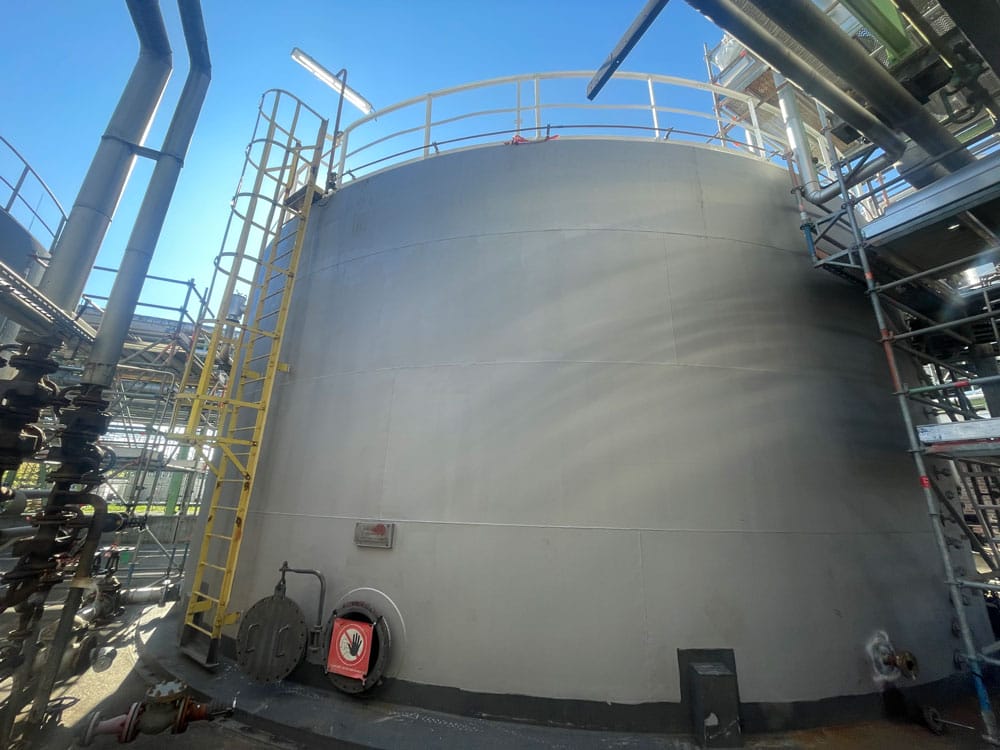
Cleaning of a complete tank shell up to a height of 21 m using a 2500 bar Multiworker from Falch, mounted on the head of a telescopic forklift truck.
There was a great deal of time pressure in this project, as the company wanted to install a new tank floor after cleaning the tank shell. Both the tank floor and the tank shell (up to a height of 2 m) were already in a cleaned condition when the tank was handed over to SOYK GmbH for cleaning of the entire wall.
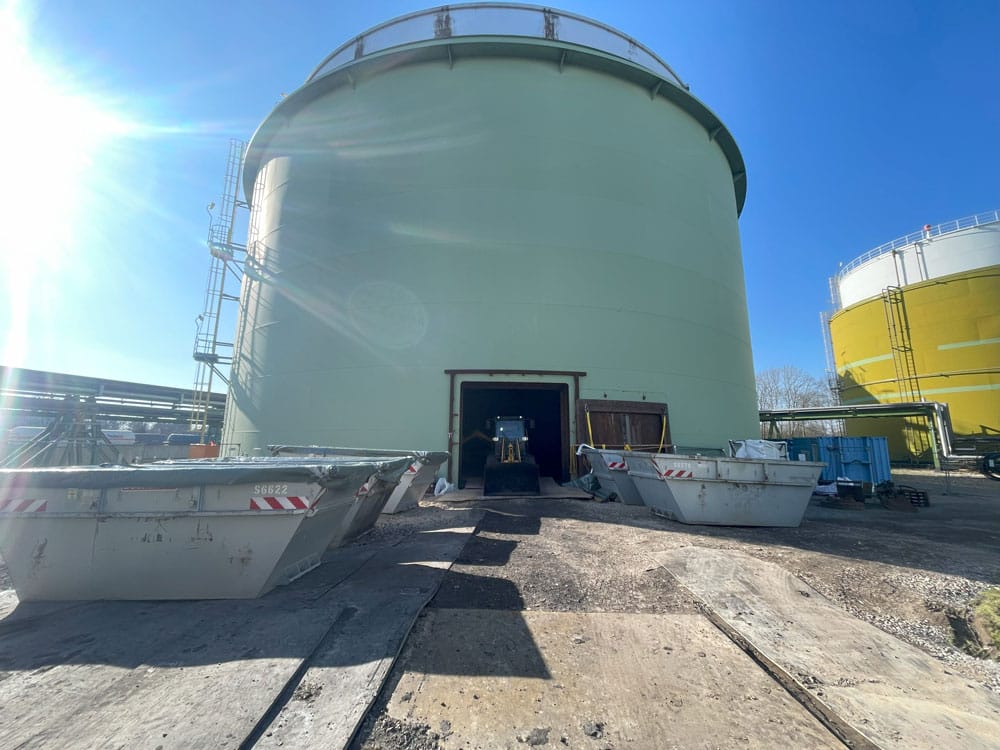
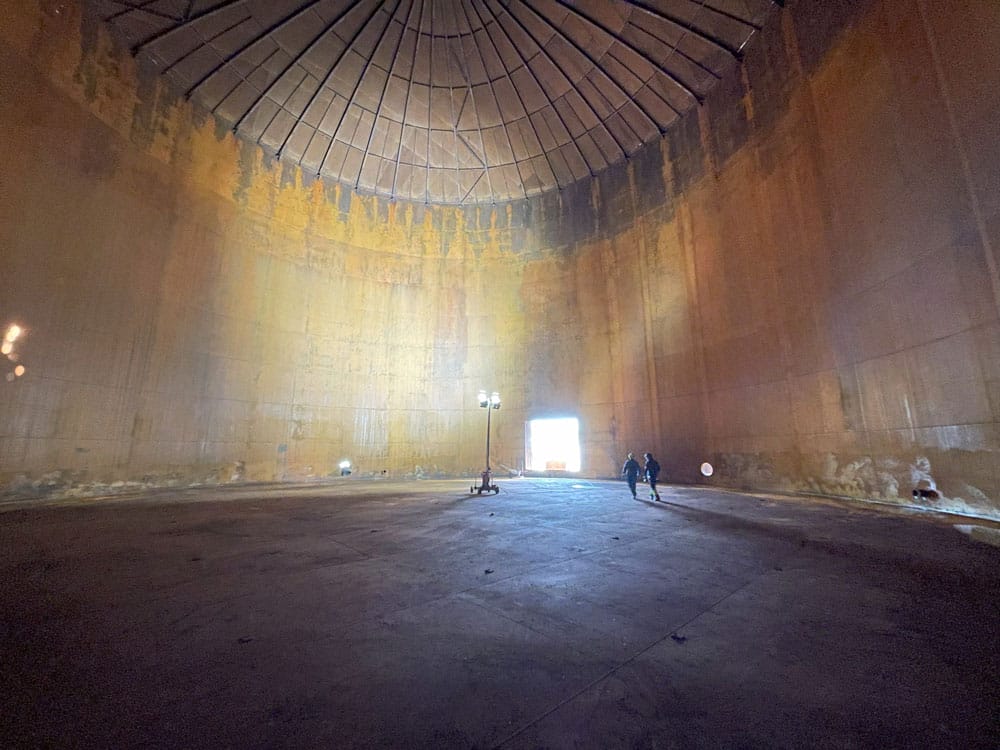
- The tank in question has a diameter of 35 m, a height of 21 m and thus a capacity of 20,000 m³.
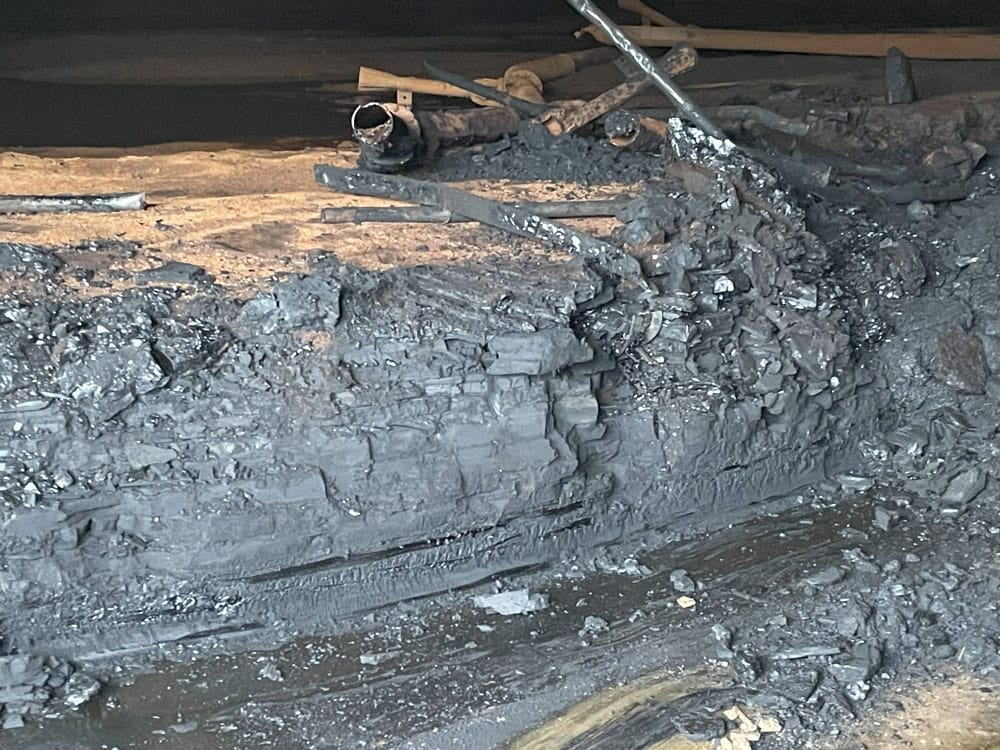
- There was a several centimeter thick build-up of the product (heavy fuel oil / HOS) on the tank shell, which adhered strongly to the wall and was also very heavily encrusted.
- The tank shell was cleaned using a telescopic forklift truck with a Falch Multiworker 250 fitted with a rotor nozzle (2,500 bar). This procedure was determined by SOYK GmbH to be the best possible and most effective cleaning method in this individual case.
- The selected method allowed the tank shell to be cleaned very quickly and also had the advantage that no people had to work in the vicinity of the high-pressure device. In addition, this method meant that no personnel were in the danger zone of the flaking product. This was also an optimal solution in terms of occupational safety.
- Once the cleaning work had been completed, the product (granular solid) only had to be pushed together from the bottom of the tank within a day and then sent for proper disposal in the incinerator.
- Finally, the bottom of the tank was cleaned again with a 500 bar high-pressure hot water unit and the resulting water was collected by a suction/flushing vehicle and also disposed of properly within the plant.
- SOYK GmbH Industrial Services was able to hand over the completely cleaned tank to the operator within a very short time (2.5 weeks), so that the new tank bottom plates can now be installed.


The tank has a tank cup with a depth of 3 m (outer diameter of the tank 36 m) and a heating coil (DN 50), which was scrapped during the cleaning of the tank. The stored product, visbreaker residue (heavy oil), was in a hardened state in the tank, as the heating line had been out of service for a long time. The remaining residual product was covered by a liquid phase consisting largely of rainwater, which had previously been removed by a vacuum truck.
Specifically, SOYK GmbH provided the following services as general contractor:
- Due to the technical conditions of the plant, it was not possible to completely empty the tank. The operator had stopped heating the product and blinded it. The consistency of the product residues was predominantly solid.
- SOYK GmbH took over the complete cleaning of the tank, which contained product residues up to 0.80 m thick.
- Installation of an auxiliary frame to stabilize the planned opening in the tank shell (including static verification).
- Insertion of a door sheet into the tank shell using a high-pressure water jet (up to 3,000 bar).
- Removal of the product using an electric mini excavator with an overpressure cabin (overpressure provided by a breathing air compressor and lifeline).
- Proper disposal of approx. 689 tons of product (visbreaker residue)
- Scrapping of the heating lines and other fixtures (roller line, level gauge pipe, sounding pipe)
- Fine cleaning of the tank using a high-pressure water jet (up to 3,000 bar).
- Expert supervision of the measure, performance of declaration analyses, organization of proper disposal.
- Physical separation of the tank body from all incoming and outgoing pipes, cleaning and scrapping of the dismantled equipment.
- Preparation of an individual cleaning concept
- Preparation of the surface in the tank reception area by means of inserting Stelcon and steel plates
- Cleaning of the crude oil tank by robot and suction truck as well as a mobile combustion chamber of our partner company SIS GmbH
- Precision cleaning with HD equipment and trained personnel in the tank
In a recent project, we took on the complete project planning of a crude oil tank cleaning system as general contractor. The first step was to create an individual cleaning concept tailored to the specific case at hand.
The residues remaining in the tank after various rinsing processes (sludge) are removed by the SOYK GmbH cleaning robot using our associated vacuum truck and our ATEX screw pump (rough cleaning).
SOYK GmbH has special cleaning robots including the associated control unit and suction trolley. In terms of occupational safety, this offers the decisive advantage that no personnel need to enter the tank during rough cleaning (access). The cleaning robot is inserted into the respective tank via an installed scaffolding ramp and a sufficiently large manhole (NW 600). The robot, on which several cameras are mounted, is maneuvered in the tank with the aid of a joystick via the associated control container. The operating personnel observe and control the robot via a screen in the control container. The robot is connected via a suction line to a suction truck or our ATEX screw pump, which then feeds the discharged product to the designated disposal point.
Any vapors generated by the cleaning process using our RTC robot are safely extracted and incinerated by the parallel operation of a combustion chamber.
After securing the floating roof (wedges from above and PEP supports from below), the final fine cleaning is carried out manually by personnel using a high-pressure water jet under respiratory protection.


Cleaning of an oil tank using a high-pressure washing head and mobile decanter system in combination with degassing using a mobile combustion chamber as general contractor.
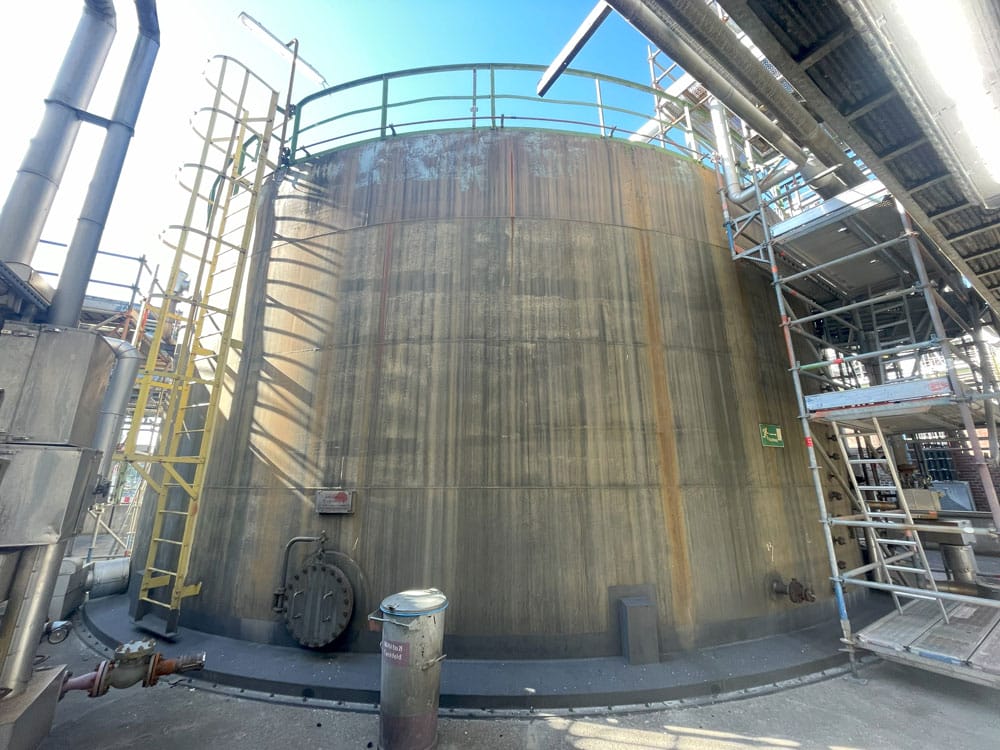
This tank was a fixed roof tank, built in 1979, with a diameter of 14.5 m, a height of 6 m, and a maximum volume of 1,000 m³.
In addition to other harmful gases (hydrocarbons), the sediment contained significant amounts of hydrogen sulfide (H2S), among other things. The sediment in the tank should be dissolved in a closed system, discharged, and treated/conditioned or separated for proper disposal in order to keep the quantities to be disposed of as low as possible.
The sludge stored in the tank generally has a flash point of < 30 °C, which meant that the issue of explosion protection had to be considered in detail. The harmful gases produced during the work were extracted from the tank’s working area and rendered harmless using a mobile combustion chamber system provided by our partner company, ETS Degassing GmbH. The use of the combustion chamber made it possible to continue the cleaning process continuously and independently of potential malfunctions in the tank’s breathing gas system, thus keeping the duration of the cleaning work correspondingly short. Failures or problems with the tank’s breathing gas system, which could lead to delays in the cleaning process, were thus ruled out from the outset.
The operator continuously supplied nitrogen to the tank. The combustion chamber was modified to ensure optimized control behavior.
The gases and vapors released during the cleaning process using a tank washing head were automatically burned in the combustion chamber in a pressure-controlled manner.
A tank washing head (TWK) fed by a high-pressure pump (HDP) was inserted into the tank via a total of four tank roof connections as work progressed.
Cleaning was carried out using a mobile A1 decanter. This system was used to dissolve the sediments with water and discharge them in batches using an ATEX pump.
The compacted sediments were first remobilized, i.e., slurried and diluted. Using the high-pressure water pump, hydrant water is fed into the tank via the nozzles of the tank washing head and the sediment is loosened in the respective working area of the rotating head.
The decanter sludge was then detoxified in various treatment steps with the addition of chemicals. Once the sediment had been removed, the tank was opened and completely degassed via the combustion chamber. After the company had carried out release measurements, the floor and walls were thoroughly cleaned up to a height of 2 m using high-pressure water (spray gun).
After the cleaning work was completed, SOYK GmbH carried out various repair work on the tank.
You want more references or examples of our work? No problem, just contact us.
Get in touchTalk to an expert
Do you have questions about our innovative products or our services as management contractor?
Management
SOYK GmbH
Am Kiefernring 16
D-21409 Embsen
Operational site
SOYK GmbH
Containerfeld 493, Unit 1b
Ludwigshafener Str. 1
D-50389 Wesseling


